Simply Oishii Wagashi School
  • Home
  • About
  • One Day Courses
    • In Person Classes
    • Online Classes
    • Team building
  • Certificate Courses
  • HOW TO BOOK
  • Information
  • Reviews
  • Blog
  • Contact
  • Access
  • Affiliate Schools
  • About Miyuki

SIMPLY OISHII BLOG

NoVEMBER WAGASHI

10/30/2025

1 Comment

 
November is month when the leaves turn color and beautiful scenery can be enjoyed just before the arrival of winter.

In the world of tea ceremony, November is a particularly significant month, known as the time of Rohbiraki (“opening of the hearth”) and Kuchikiri (“opening of the tea jar”).
As winter approaches, tea practitioners open the sunken hearth (ro) to prepare for the cold season, and they also cut open the seal of the tea jars that have been maturing since summer to begin using the new tea.
Because of these important rituals, November is often called “the New Year for tea people.”

​
Beautifully crafted jōnamagashi (high-grade fresh confection) that expresses the colors of late autumn—vivid reds and golds inspired by maple and ginkgo leaves.
With its elegant hues and seasonal feeling, it is a perfect sweet to accompany a bowl of tea during autumn tea gatherings.
Picture
As the name of the sweets are often named to describe the scenery, The sweets with autumn colors have several names:

Kinshu (錦秋)
The world Kin or Nishiki(錦)usually used to describe something beautiful, In this case a woven fabric. The beautiful autumn colors resemble a beautiful fabric. In Haiku, the word is used in late autumn poems. Wagashi makers also use this word in Autumn sweets.
Picture
Tatsutagawa(龍田川・竜田川)
This is the name of a river in Nara that is famous for the autumn colors. It's used in poems and wagashi as well as patterns in Kimonos to express autumn. 
Picture
Tatsutagawa in Nara - Photo from travel.jp (https://www.travel.co.jp/guide/article/22353/)
Inoko Mochi (Boarlet Rice Cake)
​
Inoko Mochi is a traditional rice cake sweet enjoyed to pray for good health and prosperity of descendants.
It is shaped like a baby wild boar (uribō), symbolizing vitality and fertility in Japanese culture.
Each region or shop has its own variation—some are coated with sesame seeds, others with roasted soybean flour (kinako), offering unique flavors and textures.
Picture
Chestnut Sweets
Autumn in Japan brings an abundance of chestnut-based sweets that celebrate the season’s rich flavors.
Places like Nakatsugawa in Gifu Pref, Obuse in Nagano Pref. together with Tanba in Kyoto are especially famous for Chestnut sweets.

Kuri Kinton
Made simply by steaming and mashing chestnuts, then shaping the mixture by hand in cloth into a small chestnut-like form.
Picture
Kuri Kinton - from Kawakamiya in Gifu Pref. (https://www.kawakamiya.co.jp/)
Sasa-guri Mushi (Steamed Chestnut Sweet Wrapped in Bamboo Leaf):
A delicate treat made by wrapping chestnut paste mixed with chopped chestnuts in sweet red bean jelly, then steaming it in a bamboo leaf to enhance the fragrance.
Picture
Sasa-guri Mushi from Masudaya in Aichi Pref. (https://okazaki-masudaya.co.jp/)
1 Comment

Mochi in our life

10/27/2025

0 Comments

 
In our mochi class, we explain to our guests the history and traditions of mochi. In Japan, Unlike other sweets, Mochi is not just a snack to fulfill your craving for sweets or a dessert to eat after a meal, they carry deep symbolic meaning and accompany us through every stage of life, marking important milestones and celebrations
Picture
I personally realized this as my mother passed away this month, in her funeral  the makura-dango (枕だんご)was placed near her coffin. This is so she does not go hungry on her way to heaven. 
Picture
makura dango in my mother's funeral
It all starts when a child turns 1 year old We will celebrate with issho-mochi (一升餅)as the sound of issho is the same as a life time(一生). The baby will carry the issho-mochi on their back hoping that they will live a long life. Issho is a unit for measuring rice, or rice wine holding 1.8 L. So you can imagine that the mochi is qute heavy (approx 2 kg or 4 lbs)
Picture
My son's Issho mochi celebration
 During obon months (July and August), when we believe the spirits of our ancestors will return, We will offer Ohagi or Botamochi to our ancestors., as well as okuri-dango (farewell dango) so they do not go hungry on the their journey back to the other world.
Picture
Ohagi or Botamochi (They are the same)
For birthdays, anniversaries, or the opening of a new business, mochi is presented as a lucky charm. We eat Kohaku-mochi (紅白餅)in celebrations such as weddings and birthdays. Kohaku means red and  white  which are  traditional colors of celebration—red for happiness, white for purity—symbolizing harmony and strong bonds that last.

Its round shape stands for harmony and long life, while its sticky texture symbolizes strong human connections and perseverance.
Picture
Photo from 一久大福堂(https://www.daifukudo.co.jp/en/)
Mochi accompanies the Japanese from birth to old age—from isshō mochi to makura dango in a funeral,

It is a symbol of life, prayer, and connection—a small yet powerful reflection of Japanese spirit and culture.
0 Comments

Wagashi in August

8/2/2025

3 Comments

 
August (Hazuki)
The 18-day period of Doyo/土用 before Risshū/立秋 (the beginning of autumn) overlaps with the end of the rainy season, a time when contagious illnesses are common. It also coincides with Taisho/大暑—the "Great Heat"—in the 24 solar terms, bringing continued extreme heat day after day.
​

To endure this harsh period, it has long been customary in Japan to eat nourishing foods during Doyo to restore strength, with grilled eel (unagi) on the Day of the Ox (Doyo no Ushi) being the most well-known example.
Picture
One traditional treat is Doyō Mochi—rice cakes filled with sweet red bean paste (anko). Made with azuki beans and mochi, which are believed to ward off evil and misfortune, these confections were eaten to protect the body and spirit from the exhausting heat.
PictureImage from Toraya's Official Website

Obon (Urabone) is a Buddhist event held in the seventh month of the lunar calendar to welcome and later send off the spirits of ancestors.
Today, it is most commonly observed in August, which corresponds to the seventh lunar month, although some regions still celebrate it in July. During Obon, offerings such as traditional dry sweets (干菓子) and dango (団子)are prepared.

Picture
Obon Rakugan(Dried Sweets)
The dango offered on the first day of Obon (the 13th day) to welcome the ancestral spirits are called "mukae dango" (welcoming dango). These are typically served with sweet red bean paste or a sweet soy glaze, meant to comfort the spirits after their long journey back to this world.

In contrast, the dumplings offered on the last day of Obon (the 16th day) to send the spirits off are called "okuri dango" (farewell dango). These are usually plain white dango with nothing added, symbolizing a simple parting gift for the spirits to take back with them to the other world.

During the middle of Obon, on the 14th and 15th, people often offer sweets known as "omotenashi dango" (hospitality dango) or "ochitsuki dango" (settling dango). Ohagi—sweet rice cakes covered in red bean paste—are commonly used as offerings during this time, expressing the wish for the spirits to rest and stay peacefully during their visit.
​
These offerings reflect the deep respect Japanese people have for their ancestors and their sincere desire to honor and care for them, even through the simplest of gestures.
Picture
Okuridango

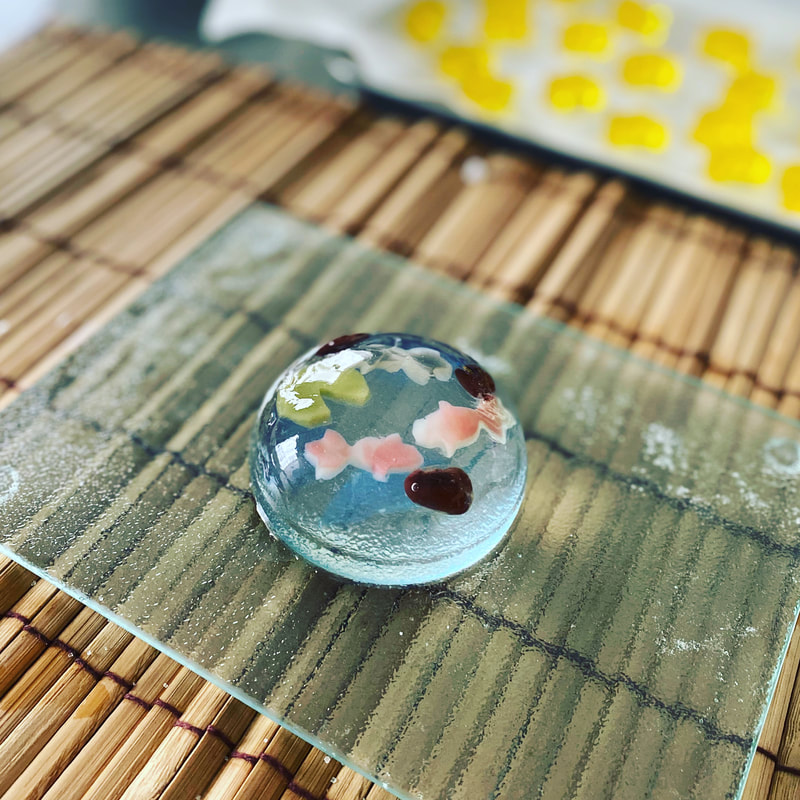
At Simply Oishii Wagashi School, we will be teaching summer motifs during this month. Typical summer motifs for nerikiri wagashi is Sunflower, Fireworks, Fan, Ayu fish, Goldfish, Morning Glory and water balloons. 

If you would like to try making these delicate sweets, you can make a booking here in our booking platform
3 Comments

First anniversary!

6/18/2025

2 Comments

 
Today, (June 18th )marks not only my last birthday in my 50s, but also the first anniversary of my company.

Eleven years ago, I started teaching classes at home. On my 50th birthday, I officially registered my business, established an association seven years later, and incorporated it the following year.

Running a company has brought greater responsibilities compared to operating as a sole proprietor. Balancing work and private life—preparing lunches for my son during exam season while managing a business I was still getting used to—was certainly challenging. But thanks to the support of those around me, especially my husband, who likely has an even busier schedule yet takes care of all the housework on weekends (and with weekday chores outsourced), we somehow made it through this first year safely.

There are so many roles a solo founder must take on—PR, product development, advertising, teaching, legal affairs, procurement, and more. But as I am approaching 60 and surviving cancer, I know I can't push myself too hard. When I feel tired, I lie down right away, and I make sure to get at least seven hours of sleep each night and take it easy on weekends. (If I had started this in my younger years, I probably would’ve been far more aggressive.)

I often act on impulse without overthinking things, and I sometimes regret it later. But seeing more than 20 graduates of my instructor training course now growing into full-fledged teachers helps reassure me that I made the right decision. After all, my goal in starting this business was to help women earn income by doing what they love.

This year, I’m finally taking the leap into international activities (yes, another spontaneous decision), and I plan to exhibit at the Japan Pavilion of the EXPO in Barcelona at the end of the year. I hope to spend the next year sharing wagashi with people around the world—and maybe even make more time for myself outside of work.

Lastly, since many guests have trouble finding the entrance to our studio, we’ve put up a brand-new sign and have a new map —thanks to the design team led by T. Shudo, a former designer at my previous Job at Sony.
Picture
Picture
2 Comments

Wagashi in the month of June

5/28/2025

1 Comment

 
June is the start of the raining season, when the steady, gentle rain makes it hard to feel cheerful. Even when the sun peeks through, the air still feels heavy with humidity and it's hard to feel refreshed. But maybe it's because this season tends to be so damp and dreary that it's the perfect time to welcome others with something light and refreshing—a way to turn the rainy season into a moment of quiet charm.
Picture
Hydrangea Flower, a popular June Motif
The garden glistening in the rain, the small, delicate flowers blooming quietly—there’s a kind of beauty that only this season brings. The tea ceremony is a great way to take a moment to notice those touches of seasonal grace and enjoy the rainy season in your own way.

Here are some popular wagashi that are served in this season:
Picture
Otoshibumi(落とし文)
Its name means "dropped letter," referring both to secret old love notes and to a type of beetle that rolls leaves to lay its eggs—like a tiny message. Otoshibumi mimics this image: it’s usually made from Nerikiri Dough with sweet bean paste as a filling.

Picture
Ayu or Waka-ayu(鮎/若鮎)
A traditional Japanese summer confection that mimics the appearance of sweetfish swimming in a clear stream. It consists of a soft castella batter wrapped around a filling of gyuhi (a soft mochi-like rice cake).


Picture
Hydrangea(紫陽花)and Green Plum(青梅) Motif Wagashi
A popular Motifs during this season for Nerikiri and Uiro, Sold in Wagashi Shops.

We have festivals all year round in Japan and one of the well known festivals in June is the  Nagoshi no Harae(夏越の祓え)/Summer Purification Ceremony

Nagoshi no Harae is a traditional Shinto purification ritual held at the end of June in Japan. The ceremony is meant to cleanse people of sins, impurities, and misfortunes accumulated in the first half of the year and to pray for good health and safety during the remainder of the year.

One of the most symbolic aspects of this ritual is the Chinowa Kuguri, where participants walk through a large ring made of miscanthus reeds (called a chinowa) as a symbolic act of purification. This act is believed to remove spiritual impurities and bring about renewed vitality.
​
The ritual is usually conducted at Shinto shrines across Japan, and it's often accompanied by prayers, offerings, and sometimes the burning or releasing in a river of symbolic objects such as paper dolls (Hitogata/人形), which are believed to absorb a person’s sins and misfortunes.
Picture
Chinowa(茅の輪)
Minazuki – A Traditional Japanese Sweet for Summer Purification
Minazuki is a traditional Japanese sweet (wagashi) commonly eaten around the time of the Nagoshi no Harae.

This confection consists of a base of white firm rice cake), topped with sweet azuki (red beans). It is typically cut into triangular shapes, which are said to represent blocks of ice. In the past, ice was a luxury item used to cool off in the summer, so the shape symbolizes a wish for protection against the summer heat and good health during the hottest months of the year.
​
The red beans are also believed to have protective qualities, warding off evil spirits. Eating Minazuki during this time is a seasonal tradition meant to bring purification and blessings for the second half of the year.
Picture
Photo from: https://all-guide.com/
If you would like to visit a shrine that has the Chinowa, please visit this website (In Japanese Only)

Tokyo:東京都 茅の輪くぐり神社リスト121社(MAP付き)|夏越の大祓
Kyoto::無病息災を願う、6月の風物詩「夏越の祓」を体験しよう!

​Simply Oishii Wagashi School will be making Early Spring Motifs starting from June. To book a nerikiri wagashi class, please go to this page this pages or contact us.
1 Comment

Wagashi In Jakarta!

5/15/2025

2 Comments

 
Last week I was in Jakarta or the second time to visit Elm's corner which is a certified school of Wagashi Promotion Association(WPA) Japan in Indonesia.

Wagashi Promotion Association is an organization I run which is dedicated to sharing the beauty and traditions of wagashi.

We are excited to have them onboard to promote wagashi in Indonesia together. In my last trip they have taken our Nerikiri Basic Course, which is a certificate course to learn the basic techniques in wagashi making.  For those residing in Indonesia, this course can be now taken at Elm's corner and be certified as an instructor by WPA. 
Picture
The team at Elm's corner
In this recent trip, I had an opportunity to take my sensei, Junichi Mitsubori's Master Class. It was a great experience to learn from the master himself as the past classes were online.
Picture
Demonstration on Nagashigashi
Picture
Mitsubori-sensei's works are out of the ordinary
Picture
The Indonesian national flag
Picture
Koi in water
Picture
Everyone seemed to enjoy the workshop!
I was also amazed that so many people took interested in wagashi making in Indonesia. Although it was not an easy course, everyone did their best to make a beautiful wagashi. I hope by this experience they would be eager to learn more about wagashi making.

WPA makes sure that all the techniques that are taught in our certified schools are authentic using classic tools and modern tools. We also try to teach the cultural background of wagashi as with it is strongly connected with our history and nature. So anyone who is taking classes or courses in our schools have a unique cultural experience, which makes it not just a cooking class.

As I have witnessed a strong interest in nerikiri making in Asia region with our popular wagashi artists holding workshops overseas, I feel that we need to introduce our Master Course as soon as possible.

We will continue to support Elm's Corner to promote wagashi in Indonesia. If there are other schools in other countries which are interested in introducing wagashi to their country, please reach out to WPA and we would be more than happy to support you.
​
For details on how to become a WPA certified school. please contact WPA using our contact form.
2 Comments

Corporate Team Building event

5/4/2025

1 Comment

 
Last month we hosted a corporate team building event at our studio for a foreign company based in Yokohama.

We started off with a short presentation on wagashi (Japanese sweets), then moved on to actually making them. First we made two seasonal motifs, the sakura and the sakura leaf. 
Picture
Picture
Then each table had to undergo the task of making original designs based on the given theme.
Picture
Picture
This table's theme was "spring". Very original and creative, with spring colors!
Both teams did a brilliant job and it was a tough call, but as this is a team building event, we chose the spring team as all team members worked together to create one artwork, 
Picture
Congrats to the winning team. They won a prize!

Picture

Picture

This table's theme was "Autumn" with autumn flowers, autumn leaf and pumpkin. What a great job!
Picture

A big hand to the autumn team. although, they didn't win the team award, one of the members received the best nerikiri award.  
Picture
After the award ceremony, they all ate one of their creations with a bowl of matcha they learn how to whisk themselves as well as learning the etiquette on how to drink matcha.

A big thank you for giving us the opportunity to host this fun event. All of our instructors also enjoyed this event too.  I personally realized again how wagashi making can be such a fun team building event with a bit of competition. 

For inquiries on corporate events please visit This page or contact us  for a quotation.

1 Comment

NEW BOOKING SYSTEM Running!

4/6/2025

3 Comments

 
As of March, we have been test running a new booking system to consolidate all our booking from Overseas Travel Agents and Direct Booking. 
From April 1st, All our bookings for Mochi and Nerikiri Class will be using this system.
Picture
You can now choose a date from our calendar and book our one day classes without having to contact us for availability. Your booking will be confirmed once you have paid for the class.

A booking confirmation will be sent to you which will inform you the details of your booking and the exact location of our school
Picture
If you are booking solo, you will need to choose a date that already has a booking. If you are not sure, please Contact us.

For certificate courses and some of our one day classes, you will still need to contact us through the Contact form for availability. A payment link will be sent to you to secure your booking.

If you have any other requests, please feel free to Contact us anytime.
BOOK A CLASS
3 Comments

Baked &Steamed Sweets COurse

1/27/2025

0 Comments

 
We have just launched our new certificate course this month.
The Baked and Steamed Sweets Course is a WPA certified program designed to share the authentic techniques of Japanese wagashi (traditional sweets) with the world. While visually stunning wagashi like nerikiri have gained attention thanks to the rise of social media, Japan boasts a rich variety of other wagashi that are equally remarkable.

Traditionally, these sweets have been crafted by skilled wagashi artisans. However, this course provides recipes that can be easily made at home. The recipes are adapted for home cooking, with adjustments to proportions and ingredients, making them accessible and delicious for anyone to prepare.

This course was created by Miho Takahashi sensei, a wagashi artisan and a rising star with a 14 year experience in wagashi making including the 7 years working at Toraya, one of the most prestigious wagashi shops in Japan. She has opened her own school last year and already becoming a popular  overseas holding workshops in Asia.

Takahashi Sensei has won a number of Gold Awards in the National Wagashi making contest.
Picture

In this 12 hour course, you will not only learn 8 kinds of popular Japanese sweets, but also learn about the ingredients that are used in Japanese sweets making as well as the background and history behind each sweet..

In wagashi making there are various kinds of flour, sugar and leaving agents, some quite unique and not heard of to most people outside Japan. 40 page textbook will tell you the difference between each ingredients and whether they can be substituted by other ingredients.

This course also comes with a tool kit which includes all of the tools that are used in the course and hard to find overseas. You will need a steamer and hot plate (or shallow frying pan) . for the course.
Picture

To learn more about this course including course fees, please visit, Wagashi Promotion Association's Website..
​
If you apply for the certificate, you will be entitled to use this recipe for commercial use including holding your own courses in your country. An annual fee of 3960 yen and a certificate fee of 22,000 is required.
0 Comments

New Years resolution

1/3/2025

0 Comments

 
Happy New Year to all of you wagashi lovers!
This year, I made a resolution to start my blog again. Since the end of the Pandemic, I have been very busy with in person classes with tourists coming into Japan.

Since I couldn't handle the sudden surge of booking coming in, I decided to train those who are interested in teaching Japanese sweets to foreigners so I can pass on some of my work to them.

Since they are doing a great job running classes, I no longer teach classes unless we are short of staff and this has given me some time to think about expanding our business.

So, I hope to update this blog more often so that you know what's going on.


0 Comments
<<Previous
    Picture

    Author

    I'm Miyuki and I teach Japanese Home cooking at my home in Tokyo.

    Archives

    October 2025
    August 2025
    June 2025
    May 2025
    April 2025
    January 2025
    February 2021
    January 2021
    May 2020
    April 2020
    December 2019
    October 2019
    March 2019
    January 2019
    October 2018
    September 2018
    August 2018
    July 2018
    June 2018
    May 2018
    April 2018
    March 2018
    February 2018
    January 2018
    December 2017
    November 2017
    October 2017
    September 2017
    August 2017
    July 2017
    June 2017
    May 2017
    April 2017
    March 2017
    February 2017
    January 2017
    November 2016
    October 2016
    September 2016
    August 2016
    July 2016
    June 2016
    May 2016
    April 2016
    March 2016
    February 2016
    January 2016
    December 2015
    October 2015
    September 2015
    August 2015
    July 2015
    June 2015
    May 2015
    April 2015
    March 2015
    February 2015
    January 2015
    December 2014
    November 2014
    October 2014
    September 2014
    July 2014

    Categories

    All
    Class Schedule
    Culture
    Diary
    From My Kitchen
    Introduction
    Lessons
    Media
    Notice
    Recipes
    Restaurants
    Shops
    Tokyo Grocery Guide
    Travel Japan
    Wagashi School

    RSS Feed

    Picture
    Picture
    Picture

service

In person Classes
Online Classes
Certificate Courses
Gift Vouchers
​Grocery Guide

Information

About
Contact
Access
​Privacy policy
日本語のサイト
Operating Hours:
Mon-Thu : 10am - 5pm
Fri & Sat :  10am -12:30pm
Sunday & Public Holiday : Closed 
© COPYRIGHT 2015. ALL RIGHTS RESERVED.
Please do not use photos or recipes on this website without written permission. Photos of students shown on this site are to be displayed on this site only and would require their consent for using elsewhere. Thank you for your understanding. ​
Picture
  • Home
  • About
  • One Day Courses
    • In Person Classes
    • Online Classes
    • Team building
  • Certificate Courses
  • HOW TO BOOK
  • Information
  • Reviews
  • Blog
  • Contact
  • Access
  • Affiliate Schools
  • About Miyuki